What is a URL shortener, and when should you use one?
August 13, 2026
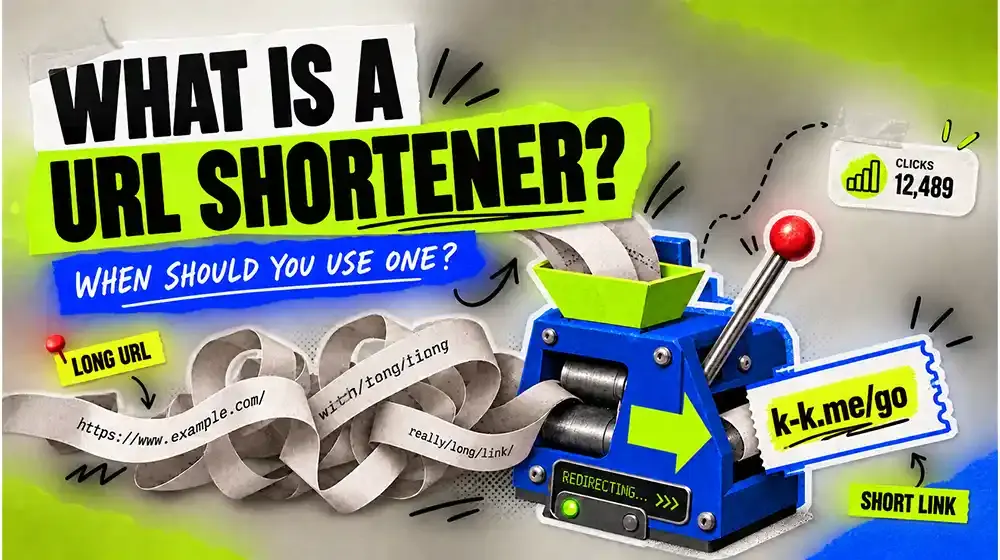
A URL shortener takes a long web address and gives you a short one that forwards to it. klick.ing/spring instead of a link with forty characters of tracking parameters hanging off the end.
The tidiness is the obvious part. It is also the least interesting part.
How it actually works
There is less magic here than people assume.
When you shorten a link, the service stores a row: this short code points to that destination. When someone opens the short link, the server looks up the code, records the visit, and sends back an HTTP redirect telling the browser where to go. The browser follows it. The whole exchange takes a few dozen milliseconds and the visitor rarely notices it happened.
Two details are worth knowing:
The redirect type matters. A 301 is permanent -- browsers cache it aggressively, and search engines pass ranking signals through it. A 302 is temporary and gets re-checked each time. Link shorteners generally use a temporary redirect, because caching the destination in the visitor's browser would break the ability to change it later. That is a deliberate trade: slightly less caching, in exchange for editable links.
The click is recorded server-side. This is why short links can count visits even when the destination has no analytics on it at all, and why they still work when the visitor blocks tracking scripts.
What short links are genuinely good for
Anything printed
This is the strongest case by a distance. A link on a poster, a business card, a package insert or a magazine page has to be typed by a human being. Nobody is typing a fifty-character URL. Some will type an eight-character one.
Print is also where the ability to change a destination later stops being a convenience and becomes essential, since the printed material cannot be edited once it exists.
Knowing what worked
If you post the same link to Instagram, a newsletter and a Discord, one destination page cannot tell you which one drove the traffic. Three short links can.
This is the same job UTM parameters do, with two advantages: the link stays short, and the counting happens on the redirect rather than depending on an analytics script loading on the destination.
Character limits
Less pressing than it used to be, but still real in SMS, where every character is billed, and in bios and ad copy with hard limits.
Links that outlive their destination
A short link is a layer of indirection, and indirection means you can change your mind. If a campaign page moves, or a product URL changes when you migrate platforms, you repoint the short link and everything that referenced it keeps working. Every email, every printed card, every old post.
Without that layer, a URL change means a dead link everywhere you ever published it.
Trust, when the link is branded
klick.ing/sale looks like it belongs to a business. A generic shortener does not, and years of spam and phishing have trained people to be wary of unfamiliar short domains. If you can use your own domain, use it -- click-through on branded short links is measurably better, and the reason is not mysterious.
The risk nobody mentions until it bites
A short link is a single point of failure.
If the service hosting it disappears, every link you ever created through it breaks at once. Not degrades -- breaks. This is not theoretical: it has happened repeatedly, and the most notable case took a very large number of links down with it.
Three practical rules follow from this:
- Keep a record of your own links. Short code, destination, where you used it. If you ever need to rebuild, this list is the difference between an afternoon and a catastrophe.
- Prefer a shortener on a domain you control. If the domain is yours, you can point it somewhere else. If it is not, you are relying on someone else's business continuing to exist.
- Do not shorten what does not need it. A link in a blog post or an email body is not improved by shortening. You are adding a dependency and hiding the destination for no benefit.
When not to shorten
- When the reader needs to see where they are going. In email especially, a hidden destination raises suspicion, and spam filters agree.
- For internal links on your own site. Search engines follow the redirect fine, but you are adding a hop for no reason.
- When you already have a short, readable URL.
yoursite.com/pricingis not improved by becomingshort.link/x7fA2q. It is made worse -- it went from self-explanatory to opaque.
The rule of thumb: shorten when a human has to type, read aloud, or remember the link, or when you need the click counted or the destination editable. Otherwise leave it alone.
Short links and QR codes
These two are more closely related than most people realise. A QR code encodes text -- usually a URL -- as a printed pattern. The longer the URL, the denser the pattern, and dense patterns are harder for a phone to read quickly, especially in poor light or from an angle.
Encoding a short link instead of a long one makes the code visually simpler and noticeably faster to scan.
It also makes the code editable, which is the entire basis of dynamic QR codes. Same idea as above: the printed thing stays fixed, the destination behind it does not have to.
A short checklist
If you are setting up short links properly:
- Use your own domain where you can.
- Make codes readable if humans will type them.
klick.ing/springbeatsklick.ing/a7Fq2xon anything printed. - Use a distinct link per channel so the numbers mean something.
- Keep your own list of what points where.
- Check them before anything goes to print. Twice.
Klick.ing includes a URL shortener with click tracking on every plan, and every short link can produce a QR code. Create a free account to try it.